
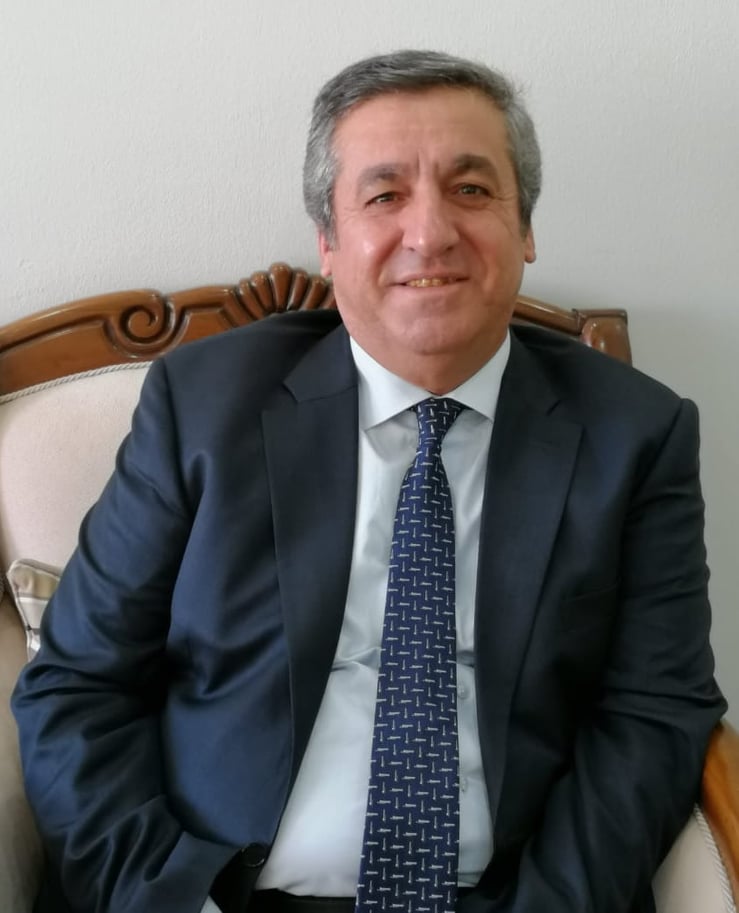
My Syriac work titled “Savto d-Mardutho / The Voice of Culture,” which I have penned as the result of a great labor, a long journey of thought, and a deep linguistic study, will soon be published and meet the reader.
Savto d-Mardutho (ܨܰܘܬܳܐ ܕܡܰܪܕܽܘܼܬܳܐ), within contemporary Syriac literature, is not merely an aesthetic text production; it is an effort to re-establish and render visible the multi-layered relationship between language, culture, and thought. In this work of mine, by centering the possibilities of expression of classical Syriac (kthobonoyo / guşmo), I aimed to reconstruct both philological continuity and intellectual depth within today's context.
The concept of Savto (ܨܘܬܐ) in the title of the work possesses a multi-layered world of meaning in Syriac. This word expresses not only a "voice" or "sound," but at the same time a "call" and the "echo" that this call leaves within time and space. Therefore, Savto d-Mardutho (ܨܘܬܐ ܕܡܪܕܘܬܐ) is not just "the voice of culture," but an expression of a call inviting culture to remember itself anew, and the echo that this call leaves in the human mind and collective memory. With this aspect, the work carries the character of a conscious cultural intervention against the negative effects of entropy.
The thematic structure in the book aims to establish a balance between inner depth and outer responsibility. In this context, the texts do not merely direct the human being to their own inner world; they also invite them to rethink their existence in the world through an ethical and cultural perspective.
The intellectual backbone of the work is shaped around two fundamental concepts: truth and love. However, these concepts are treated not as abstract ideals, but as a method and orientation. Truth is searched for not on the ground of opposition and conflict, but in the serenity of wisdom and contemplation. Love, on the other hand, is positioned not merely as an emotion, but as a restorative and constructive principle. In this direction, the work also redefines the understanding of discipline: it proposes an approach that is constructive rather than destructive, and healing rather than exclusionary.
Linguistically, the work consciously utilizes the structural and semantic subtleties of classical Syriac. The arrangement of words, the gradual unfolding of layers of meaning, and the rhetorical density render the text powerful not only in terms of content but also formally. With this aspect, Savto d-Mardutho offers a significant contribution toward the re-breathing of the language within modern Syriac literature. For Syriac culture, which is nourished by the ancient wisdom tradition of Mesopotamia, gained a new horizon of meaning with Christianity, and deepened through theological, philosophical, and literary productions. In this book, culture is treated not as a static heritage, but as an area that is in a constant state of becoming, living, and renewing itself.
Consequently, Savto d-Mardutho carries the claim of offering a contribution in contemporary Syriac literature in terms of both content and method. My purpose with this work is to reproduce cultural memory through the subtleties of language and to invite the reader to an intellectual, ethical, and spiritual questioning. For a human being develops not by defending, but by questioning.
This book has been written not merely to be read, but to be contemplated upon, to be interpreted over and over again, and to be rediscovered each time.
Because here, Savto is not merely a voice: it is a call. And that call, echoing through time, returns back toward the human being themselves.
Yusuf Beğtaş
You can also send us an email to karyohliso@gmail.com


Leave a Comment